


UPS in data center
Industry Trends News, 2020.8.17
Have you ever experienced a sudden power failure while editing a Word document on your PC? You could lose all your unsaved data. The same risk applies to data centres. When a power failure occurs, server operations may shut down immediately, potentially resulting in significant data loss. To ensure information remains available at all times, data centres are designed for maximum reliability. For example, many data centres are equipped with highly reliable UPS systems to provide backup power.
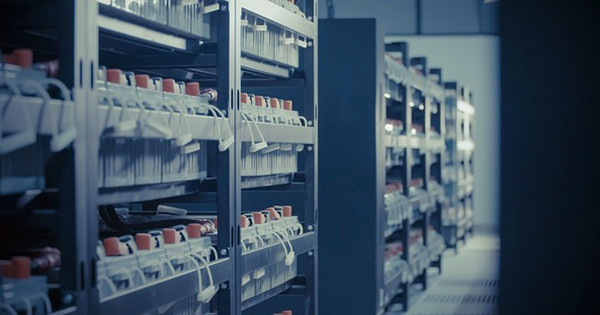
A UPS (Uninterruptible Power Supply) is a device that provides continuous power to critical equipment during power outages and other power disturbances, such as voltage drops and surges. Equipped with an energy storage unit, such as a battery or flywheel, a UPS can supply power when the main source is interrupted. When mains power is available, the UPS charges its battery and remains in standby mode. UPS systems play an important role in protecting the entire electrical infrastructure of a data centre.
1. Provide reliable backup power for data centres
Unlike a generator, a UPS provides backup power with zero transfer time. Depending on the capacity of the installed batteries, it can supply power for a period ranging from a few minutes to several hours, giving you time to switch to an alternative power source or save your data safely.
2. Provide clean power for sensitive IT equipment in data centres
Mains power can contain various disturbances, including voltage sags, swells, harmonics, overvoltages and spikes. IT servers are highly sensitive to these power quality issues. If IT equipment is directly exposed to unconditioned power, server failures may occur. In some cases, excessive voltage can even damage the equipment. A UPS helps mitigate these disturbances and delivers stable, conditioned power to your servers.
However, what happens if a UPS fails during a power outage? According to a 2016 survey by the Ponemon Institute, UPS system failure remained the leading cause of unplanned data centre outages.
In addition to regularly monitoring UPS battery status, ambient temperature and cell voltages, engineers should follow battery maintenance best practices and perform capacity testing as required. They should also consider ways to minimise the risk of failure under worst-case conditions. One effective approach is a redundant power design.
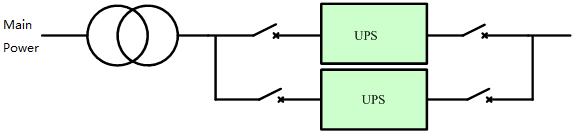
N+1 Redundancy
"N" represents the total UPS capacity required to support the full load, while "+1" means that one additional UPS module is installed as a backup.
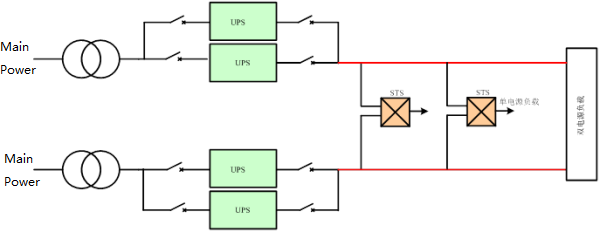
2N Redundancy
"2N" refers to a dual power supply configuration. An A-side and a B-side power path can independently supply the IT equipment. Each side is designed to support 100% of the total load. This configuration is known as 2N redundancy.
Over the years, UPS technology for data centres has developed rapidly. Modern systems are more efficient, easier to deploy and more reliable. When selecting a UPS brand or designing a UPS configuration for a data centre, consider all relevant factors to ensure stable and reliable operations.
