


Data Center Cooling:The History And The Future
Industry Trends News, 2020.11.4
It is no secret that data centres are among the world's largest consumers of electricity. In recent years, the industry has experienced a significant increase in power density, creating greater cooling challenges. As rack densities continue to rise, cooling systems are also evolving. This article explores the history and future of data centre cooling systems.
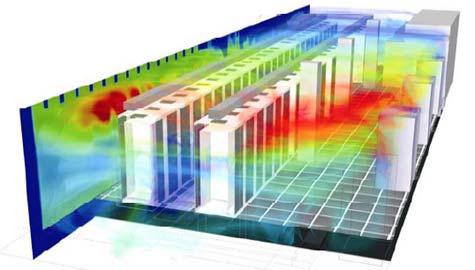
Over the past 20 years, computer rooms and data centres have used raised floor systems to deliver cool air to servers. Ventilation openings are installed in the floor near the server racks. Cold air from computer room air conditioning (CRAC) and computer room air handler (CRAH) units is supplied to the space beneath the raised floor and then flows through perforated floor tiles into the area in front of the servers. After passing through the servers, the heated air returns to the CRAC/CRAH units for cooling, usually after mixing with the cold air.
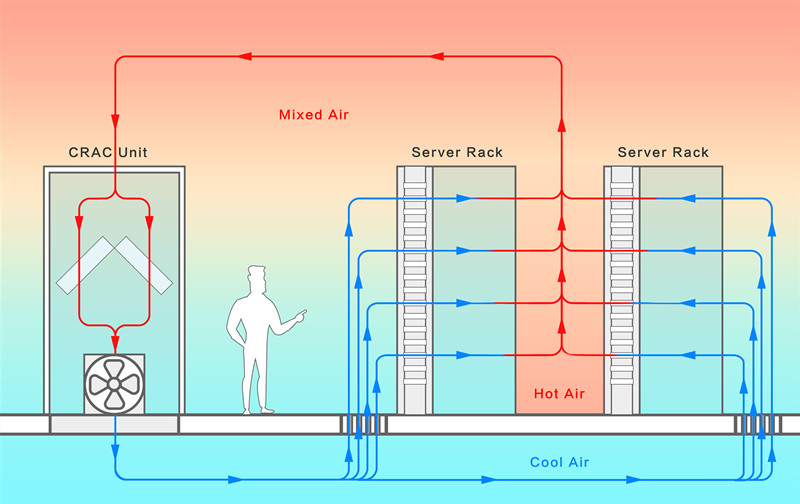
This arrangement was sufficient to dissipate the heat generated by servers when data centres were primarily occupied by low-density IT equipment. As a result, it remained a popular cooling method for several decades, despite its low efficiency and uneven cooling performance.
Around 2005, data centre experts and operators began testing containment systems. Physical barriers were introduced to separate the cold air supplied to server inlets from the hot air exhausted by servers. Preventing the mixing of cold supply air and hot exhaust air can significantly improve cooling efficiency and save energy.
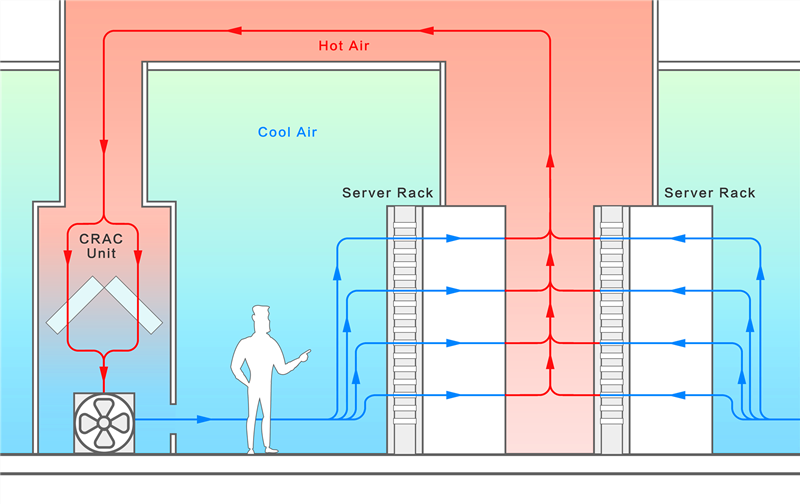
In recent years, power density per rack has continued to increase, reaching around 20 kW. Under these conditions, CRAC units and hot and cold aisle containment may no longer provide sufficient cooling. To address this challenge, data centre cooling vendors have developed closed-coupled cooling (CCC) technology.
The goal of CCC is to bring heat removal as close as possible to its source: the equipment rack. Moving the air conditioner closer to the equipment rack can improve energy efficiency and help eliminate hot spots. Combined with a hot or cold aisle arrangement, this technology can deliver even greater efficiency.
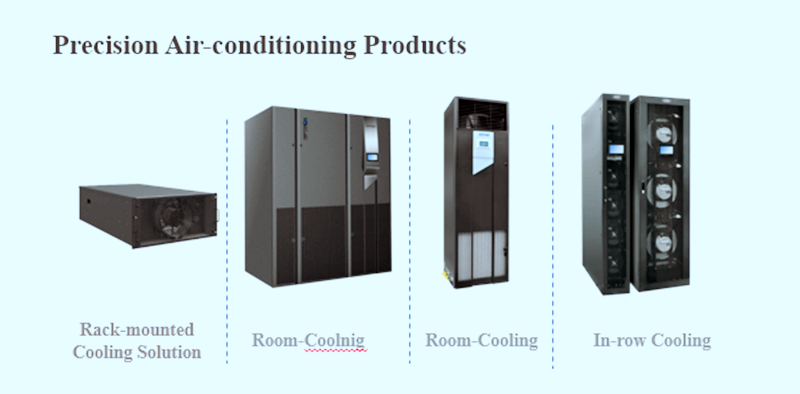
Closed-coupled cooling technology includes in-row, in-rack, in-room and above-rack cooling configurations, among others.
In-Row Air Conditioners: These units are installed between rows of server racks. Air follows relatively short, direct paths, reducing the power required to operate the fans and improving energy efficiency.
In-Rack Cooling: Rack-based airflow paths are even shorter and precisely defined, making them less affected by installation variations or room constraints. This approach offers high flexibility, fast deployment and support for extremely high rack densities, but it comes at an additional cost.
Another emerging cooling method is direct liquid cooling at the chip level. It may be worth considering when rack densities reach as high as 100 kW per rack. Although more expensive, liquid cooling is more efficient because water transfers heat more effectively than air. It can also offer environmental benefits. Google announced in 2018 that it was using liquid cooling in its data centres, while Facebook used seawater to cool one of its data centres.
Air-based and liquid-cooling technologies will continue to reshape cooling in the data centre industry. According to Belady, a former engineer at Hewlett-Packard, "High-performance computing is likely to use liquid cooling, while enterprise data centres and internet data centres, such as Microsoft's data centres, will continue to use air-cooling methods.”
